


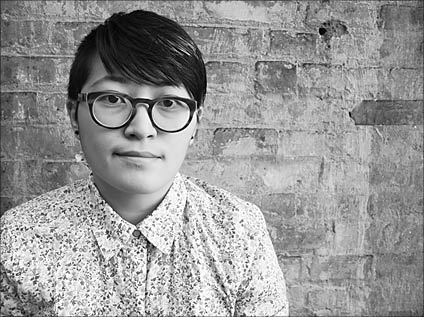
A contemporary Kazakhstani artist. Her works include animation, video, graphics, and photography. Key methods in D. Yun’s practice cover found footage, field research, and participation. Key themes are play, memory, post-Soviet identity, migration, everyday life, corporeality, and feminism.
D. Yun studied at the KIMEP University (Faculty of International Journalism, Almaty, 2005–2008), the Cooper Union (Faculty of Graphic Design, New York, 2010–2014), and the University of California, Berkeley (UX/UI Design, California, 2016, 2019). As part of the Menschel Fellowship, she researched the dombra-playing tradition and its surrounding musical and social context (2013).
In her practice, D. Yun combines anthropology, ethnography, and archival approaches to study migration and memory. The main focus of her research is fragments of everyday life – candy wrappers, buses, toys, and street interviews (“My America / Brighton Beach Memory Exchange,” 2012). The everyday becomes a game, and history turns into a visual novel. Together with Regina Shepetya and Malik Zenger, D. Yun recreated events of World War II through claymation scenes set against archival video footage (“World War Too,” 2008). Beyond research purposes, her video works also engage in activism, confronting viewers with prejudice toward women and queer people (“ASIAN DIKE,” FemLink WONDER collage, 2014).
D. Yun’s works were presented in Kazakhstan and abroad: “House of Tolerance” (Soros Center for Contemporary Art – Almaty, 2008), “East of Nowhere” (Fondazione 107, Turin, 2009), “Apples in Bushwick” (The Living Gallery BK, Brooklyn, 2013), and “Video Večer / Video Evening #18” (Photon Gallery, Ljubljana, 2018).
Information about D. Yun is stored in the collection of the Documentation project – the archive of the Soros Center for Contemporary Art – Almaty (SCCA).
Photograph from the Time.kz website