


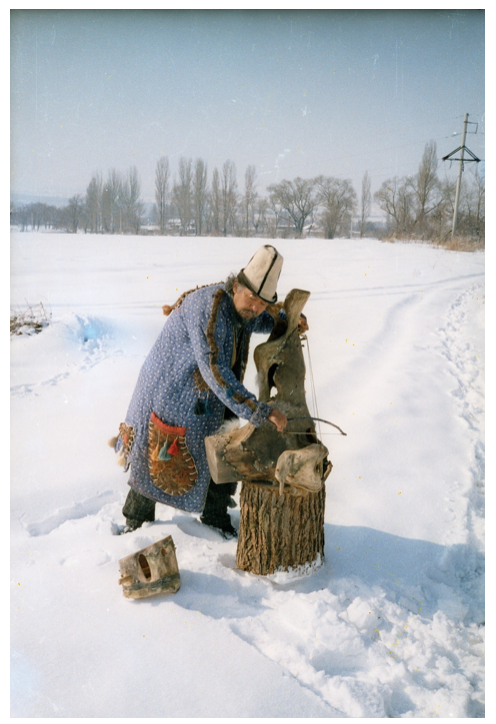
A contemporary Kazakhstani artist, founder of the art group “Kyzyl Traktor.” His work includes graphics, painting, musical instruments, sculptures, installations, and performances. Key methods in his work cover deconstructivism, semiotics, improvisation, experimentation, and surrealism. Key ideas are the search for cultural identity, shamanism, collectivism and individualism, and everyday life.
M. Narymbetov studied at the P. Benkov Art School in Tashkent (1974) and the Art and Graphic Faculty of the Abai Kazakh State Pedagogical Institute (1990). In his practice, M. Narymbetov transfers local mythologies to the soil of European avant-garde art (“Matisse’s Dance of the Kyzyl Traktor group,” 2000) and fits them into a contemporary context (“100 Bal Bals,” 2012). He experiments with color in painting (“Aul,” 2007) and with form in sculpture — for example, in the creation of musical instruments (“Drum-piano,” 2000). M. Narymbetov uses local materials — leather, wood, and felt — in the creation of sculptures (“Apashka,” 1997–1998) and installations (for the performance by Moldakul and Hans Angerer, “Dialogues of Metal and Wood about the Seventh Heaven,” 2001). All these works follow the idea of the fusion of art and life.
M. Narymbetov’s artworks were exhibited in Kazakhstan and abroad: a solo exhibition (Bal Bal Gallery, Shymkent, 1994); a solo exhibition (Fine Arts and Technical Design School named after A. Kasteyev, Almaty, 2012); “Aruaqtyn Tusi” (National Museum of the Republic of Kazakhstan, Astana, 2017); “The Black Whirlwind on Blue or Bright Green–Blue Background” (Erarta, St. Petersburg, 2018); “Takyr – Craquelure” (2024). As part of the Kyzyl Traktor group, he participated in such exhibitions as “Shymkent-Transavantgarde” (Exhibition Hall “Cathedral,” Almaty, 1990), “Transzedenz” (Kunsthalle, Vienna, 2000), the Prague Quadrennial (Prague, 2003), “Sound OFF” (Korkut Sonic Arts Triennale, Yhlas Museum of Folk Musical Instruments, Almaty, 2024).
Works, photographs of works by M. Narymbetov, and information about him are stored in the Şağylys collection, developed by the Tselinny Center of Contemporary Culture and M HKA – Museum of Contemporary Art.
Photograph taken by Arystanbek Shalbayev